Showing posts with label Dalit. Show all posts

Sunday, 9 March 2014

Arvind P. Nirmal Memorial Lecture


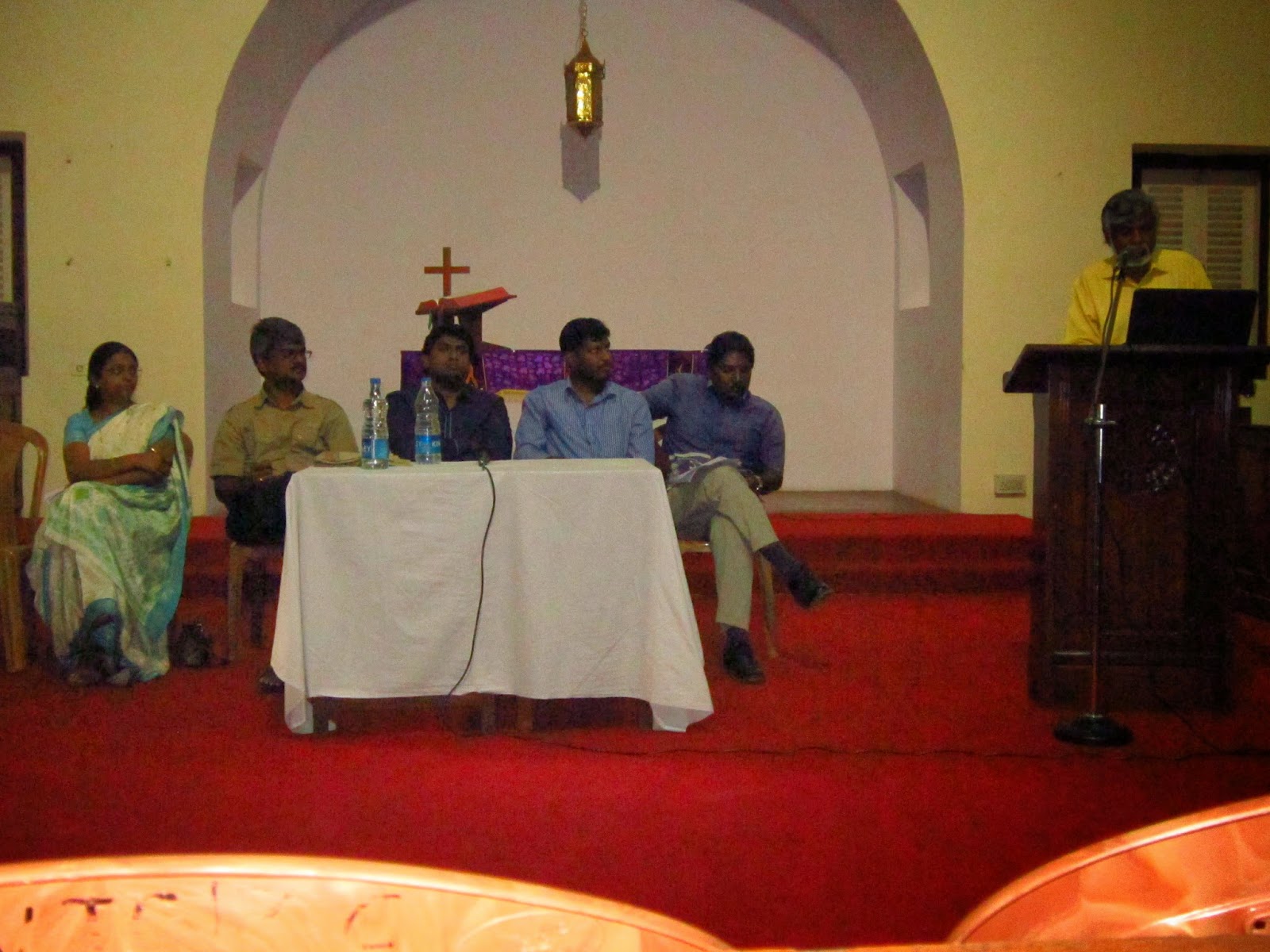
The Carey Society of the United Theological College and the Student Christian Movement India (SCMI) jointly organized the Arvind P. Nirmal Memorial Lecture on 6th March 2014 at the United Theological College. The guests and participants were welcomed with a drum beat, a unique aspect of dalit culture.

The programme began at 5.00 P.M. and was presided over by Mr. Paul Karunakar Nalla, Unit Secretary, SCMI. The opening prayer was done by Ms. Aosenla Jamir, Study Secretary, Communication Desk, SCMI. Rev. Raj Bharath Patta, General Secretary, SCMI delivered the welcome address and reminded everyone of the contribution of Prof. A. P. Nirmal towards the emergence of dalit theology as a mainstream department of study in Christian theology. He also talked about the gravity of issues of the dalit Christians of India today. The guest for the programme, Rev. Dr. Y. Moses was introduced by Mr. Inbaraj Jeyakumar, Study Secretary, Fellowship Desk, SCMI. The guest was felicitated by Rev. Dr. Evangeline Anderson Rajkumar, Professor at UTC. 


Rev. Dr. Y. Moses, presented the lecture on the issues pertaining to the Dalit Christian across India. The detailed presentation about the power sharing of dalit Christians in the church clearly reflected the state of the dalits Christians in the Indian church. The lecture helped the students and theologians to realize the oppressed state of the dalits among the Christians in India. Two students from UTC, Prashanth Babu, BD IV and Archana, BD III presented short reflections. The gust responded and clarified the queries from the floor. Vote of thanks was proposed by M. Prashanth Babu, Secretary, Carey Society. The session ended with prayer by Rev. Angela Veronica.

Paul Karunakar Nalla,
Unit Secretary, SCMI.


JK

Saturday, 1 March 2014

Arvind P. Nirmal Memorial Lecture


The Arvind P. Nirmal Memorial lecture jointly organized by the Student Christian Movement of India and the Carey Society of the United Theological College will be held on March 6, 2014 at 4:30 P.M. in the Ziegenbalg chapel of the UTC. The main address will be given by Rev. Y. Moses, Director of the Ecumenical Institute for the Empowerment of Dalits.

Monday, 25 November 2013

Interaction with Dalit Christian Colony


The BD students doing a course on Dalit Theology had a meaningful exposure to a dalit colony known as ‘Christian Colony’ in Kalinayakahalli, about 60 kms from Bangalore, Karnataka on 24th November, 2013. This was arranged as a part of the Dalit Theology course on behalf of the Department of Theology and Ethics of the United Theological College by Dr. George Zachariah and Rev. Raj Bharath Patta, the course instructors. The students from the Student Christian Movement in India also joined the exposure. The intention of this visit was to give a wider exposure to the life and spirituality of rural Dalit Christians so as to understand the dalit realities which would help the students in their discourses of doing Dalit Theology from the perspective of the Dalits and Dalit Christians.


The session began by participating in the communion worship service in the village church followed by group discussions about various aspects and issues of the local Dalit Christians in general and dalits in general. Rev. Raj Bharath Patta, lead the students through a profound exposure to the Christian dalit issues and thus helped in understanding the importance of Dalit Christian realities in doing Dalit Theology. Rev. Rueben Manohar, a UTC alumnus and pastor in this congregation in Kalinayakahalli was instrumental in explaining the life-style, Christian faith and spirituality and issues pertaining to the Dalit Christian realities. Later the students visited the dalit colony and interacted with the people to know better about the dalit life and spirituality. The students discussed the issues that caught their attention and sought clarifications and insights from Rev. Raj Bharath Patta and Rev. Rueben Manohar. The visit was very helpful for the students in forming and articulating theology from the dalit perspective and thus addressing the issues of oppression, alienation, marginalization and humiliation. 


The students felt that this exposure gave a better understanding about the life realities and situations of rural dalit Christians and expressed sincere gratitude to the course instructors, Dr. George Zachariah and Rev. Raj Bharath Patta and to the SCMI for organizing such a meaningful exposure. It was also suggested that more such exposures could help in doing theology in dalit and subaltern perspectives in a better way.


Photos and report- Paul Karunakar, BD III


JK

Tuesday, 23 July 2013

Remembering Ilavarasan, Interrogating Casteism: Reimagining Christian Public Witness in India

Dr. Mohan Larbeer
Rev. Raj Bharath Patta
A public lecture on the topic "Remembering Ilavarasan, Interrogating Casteism: Reimagining Christian Public Witness in India" was held in UTC at 5:00 P.M. yesterday. Rev. Raj Bharath Patta, the General Secretary of the Student Christian Movement India (SCMI) gave the main lecture and it was moderated and commented on by Dr. Mohan Larbeer, the secretary of the Board of Theological Education of the Senate of Serampore College (BTESSC). The lecture was jointly conducted by UTC and SCMI.

Rev. Raj Bharath Patta explained the loss of life of Ilavarasan, a dalit man, as a murder and something for which all are responsible. He gave a blow by blow account of the issue which lead to the death of Ilavarasan. The violence of the Vaniyars against dalits was brought out clearly. He saw the incident as
1. The violence against dalit communities after inter caste marriages.
2. There is a anti-dalit hate campaign and also an attempt to say that they are coming up and dressing up like others.
3. There is a political conspiracy to spit venom against dalit communities and this is for the creation of an electoral constituency.
4. There is an ongoing increase of suicides among dalits in various places.
5. There is a nexus between caste and politics, caste and patriarchy and caste and power.

For Raj Bharath the need to remember Ilavarasan today is that he reminds us of several others and their struggles against injustice. Ilavarasan reminds us of Rosa Parks, the modern civil rights movement and the life of resilience. Ilavarasan also reminds us of Nelson Mandela and archbishop OscarRomero. Rev. Bharath pointed out that high caste Hindu educated youth are campaigning against inter caste marriages and saying that their crusade is to preserve Indian traditions. He therefore said that inter caste marriages are the need of the hour if we have to thwart false traditions. Dr. Ambedkar also had such a view.

Rev. Bharath then articulated the problem of caste with what Felix Wilfred and Satish Deshpande have written and talked about as our silence on caste. Rev. Bharath finally brought in an analysis from the bible in the form of the story of Cain and Abel and said that Ilavarasan's death is like Abel's death. It was not death but murder. The retort of Cain "Am I my brother's keeper?" is what we are doing by not talking about Ilavarasan. Good news for the poor is bad news to the rich.

He then talked of a positive story in the bible regarding Ruth and Boaz and how their marriage was inter-territorial and went beyond set boundaries. This is the same route the church must take in India. He ended with a letter written to Ilavarsan confessing our inability to help him and affirming that Ilavarasan is now an epitome of hope to the community.

Dr. Larbeer started by saying that he has always been a supporter of inter caste love marriages. He gave a succint report on the real situation of caste in Tamil Nadu referring to the problem between the Vaniyar dominated PMK and the dalits. He brought out the key issue of the economics of caste and how this was also very much an issue of how the social upward mobility of the dalits was a problem to other castes. He also reminded those present of the new expression of dalit capitalism. He ended by saying "No one can murder or kill love." Students and faculty from UTC and the SCMI unit from Goodwill Women's Christian College attended the lecture.

Dr. Sahayadhas introduced the speakers, Dr. Allan Palanna and Dr. George Zachariah made venue arrangements and took care of logistics, Ms. Veronica, MTh II and Mr. Paul Karunakar, BD III helped in the conduct of the programme and Rev. Dinesh, MTh II offered prayer.


Friday, 16 November 2012

Carols unheard: A call for an inclusive Christmas


The Christmas season brings in memories of the commemoration of the birth of Jesus, celebration, carol songs, church services, community activities and sharing of food. Each church denomination celebrates the birth of Jesus with pre-prepared services and prayers. Carol songs in English and the vernacular are sung in houses and churches and people of all communities, castes and groups get together in their own celebrative ways.

The Carol songs we sing and listen to are traditional and well known to many. But there are limitations with language, context and lyrics. Many a time this is brushed aside and we get together in the spirit of the Christmas season forgetting everything else. But Carol songs are much beyond of what we know. Several communities have expressed their feelings and emotions about Jesus, his birth narrative and how Jesus gives hope and life in the midst of oppression and discrimination.

Such songs have been unheard, unseen and unsung by the mixed communities in churches, theological colleges and seminaries. Various dalit communities in different states of India have always sung from deep within their consciousness of being oppressed for centuries together. Such a deep consciousness finds support from the babe who was born in the midst of nothingness. Despite having everything, Jesus chose to be born in this nothingness, thereby associating himself with those who have been deprived their rights and their humanity. Carol songs gain deep meaning when sung from the consciousness of various dalit communities.

The United Theological College and the NationalCouncil of Churches in India (NCCI) have always stood for helping to build a church which should try hard in getting rid of caste, gender, and all sorts of discriminations within and outside the church. As part of this commitment the NCCI with support from the Evangelisches Missionswerk in Germany (EMW) and in partnership with the Department of Communication, UTC decided to bring out a CD on “Carols unheard: Christmas Carols from Dalit perspectives.”

The talks about how this could be done were done in the early part of 2012 with liaison work happening between Rev. Sunil Raj Philip, the secretary of the Dalit Desk of the NCCI, and an alumna of the college, and the Communication Department in the UTC. The actualization of the project happened on November 2,3,4 and 5 with recording done in the UTC recording studio. The release of the CD was held on November 6, 2012 with the first copy being released by the principal of the UTC, Rev. Dr. John Samuel Raj and the first CD being given to Rev. Dr. Vincent Rajkumar, Director of CISRS and Executive member of the NCCI. The students, faculty and staff of the college graced the occasion.

The songs have been written, set to tune and sung by students from various theological colleges and the UTC. The songs include Oriya, Tamil, Hindi, Telugu, English and Malayalam songs. Students from various states starting from the North East till down South were the backbone of this venture. The songs reflect the self-determination of the dalit communities and will be an inspiration to all the churches in India. We hope that this Christmas season will be more meaningful with the dissemination of these songs.

The songs are available for free download from http://soundcloud.com/commission-on-dalits-ncci This we hope will ensure the easy and concerted distribution, listening, appreciation and internalizing of the songs by the UTC alumni, various church denominations and Christians at large in India and all over the world. May we listen to these songs and be able to hear the unheard during the birth of our Lord and saviour Jesus Christ.


(Photo credit: Rev. Sunil Raj Philip). JK

Friday, 18 May 2012

Bishop Dr. M. Azariah passes away

 
Rt. Rev. Dr. M. Azariah, the former bishop of Madras Diocese went to his eternal abode yesterday. The funeral service will be held at St. George's Cathedral, Chennai today.

Bishop Azariah was presently the chief functionary of the Ecumenical Council for Drought Action and Water Management (ECoDAWM) which is a constituent member of the NCCI Council. Dr. Roger Gaikwad said Bishop Azariah was in the staff team of the National Council from 1975 to 1977 as Mission Secretary and Secretary for Christian Education Council of India. Bishop Azariah served the Church of South India Synod as its General Secretary (1982-1990). He started his ministry as a rural Pastor in CSI Madras Diocese, and he had taken up the Office of the Welfare Officer of the Leprosy Mission Hospital in Manamadurai. He also served as the Tamil Nadu Auxiliary Secretary of the Bible Society of India (1976 and 1981).

He was known for his Dalit commitment. He ministered the Dalits throughout his life as a church worker,leader, writer and teacher. He was instrumental in promoting several Dalit movements and organizations and made the churches to accompany the Dalits in their struggle for freedom towards equality, dignity and inclusiveness.  He was described as ‘the pillar’ of Indian Dalits and Dalit movements and was the ‘Dalit voice’ to the nation, church and ecumenical movement at one point of time. Bishop Dr. Azariah also taught in the Gurukul  Lutheran Theological College till recently. 

The UTC principal, faculty, staff and students pray and give thanks to God for the life of Bishop Dr. M. Azariah and offer condolences to his family members and bishop, pastors and laity of the CSI Madras diocese.