A public lecture by Prof. Dr. David J. Chalcraft on the topic "Sociological Approaches in Old Testament Studies" will be held on August 1, 2014 in the Tagore Hall of the UTC at 4:30 P.M. All are welcome.
Post Box No. 4613, 63, Miller's Road, Benson Town, Bangalore- 560046, Karnataka, India. Telephone:91-80-23330015(Principal), 23333438, 23330502 (General). Fax: 91-80-23330015 Email:utcprincipal@rediffmail.com, unitedtcprincipal@gmail.com
Showing posts with label Biblical studies. Show all posts
Sunday, 27 July 2014
Public Lecture on "Sociological Approaches in Old Testament Studies"
A public lecture by Prof. Dr. David J. Chalcraft on the topic "Sociological Approaches in Old Testament Studies" will be held on August 1, 2014 in the Tagore Hall of the UTC at 4:30 P.M. All are welcome.
Sunday, 20 July 2014
Thursday, 6 February 2014
Bible Darshan: Conference Summation
CONFERENCE
PROFILE
The Bible Darshan – An International Conference,
hosted by the Department of Biblical Studies at the United Theological College, Bangalore is a
unique experiment to be cherished, in the long history of the College. This is particularly
because of the distinguished guests and participants, who represented eight
different nations (Australia,
Germany, Kuwait, Myanmar,
Nigeria, UK, Sweden
and the host – India).
Participants from India represented twelve states (Andra Pradesh, Araunachal Pradesh,
Bihar, Kerala, Maharashtra, Meghalaya, Mizoram, Nagaland, Tamilnadu, Uttar
Pradhesh, Uttarakhand, and West Bengal) and one Union territory (Delhi), thus covering North to South and
East to West of India.
Under the
theme Exploring the New Frontiers for
Post-Western Biblical Studies, the conference attempted to challenge biblical scholars
in India and in the West to engage with one another, share insights with each
other and evolve new frontiers for further research in India/Asia, thereby
seeking to engage with texts and contexts for future engagement in the country
and beyond.
INAUGURAL REPORT
The long awaited Bible Darshan, an international conference, hosted by the
Biblical Studies Department of the United
Theological College,
deliberating the theme, Exploring New
Frontiers for Post-Western Biblical Studies from 30th to Feb.1,
2014 was inaugurated on Jan 30th at 10:00 A.M. in the Ecemenical Resource Centre of the UTC. The “Lighting of the Lamp”, a
symbol of Invitation and Life was initiated through Dr. J. R. John Samuel Raj,
Principal, UTC, Dr. Mohan Larbeer, Secretary, BTESSC, Dr. Monica Jyotsna
Melanchton, Professor of Old Testament and Secretary, Society of Biblical
Studies in Asia (SABS), Dr. Vasanth Rao,
Principal ACTC and President Society for Biblical Studies in Asia (SBSI)
and Dr. David J. Chalcraft, Professor of
Old Testament, University of Sheffield, UK. Dr. Dexter S. Maben, Coordinator,
Bible Darshan welcomed and introduced the distinguished participants from home
and abroad.
Dr.
J. R. John Samuel Raj in his inaugural address, extended his greetings and made clear the college's happiness in hosting the conference here. He expressed, “UTC is a
meeting point of God’s people.” He added, it is the first ecumenical college in
Asia that has journeyed for 104 years till
date. It is the place where Shudra Theology and Dalit Theology emerged. It also
has an advanced post-graduate and doctoral program under the Serampore University. By the 1970s, UTC became a place for inter-religious studies and
dialogue and a very important India-Pakistan dialogue took place in the campus.
Reflecting
from 2 Timothy 4: 1-5, the principal talked on perseverance in life. Teachers
from around the globe who taught at UTC have always encouraged the students to persevere
and carry out the ministry and responsibilities throughout the world.
Instrumental
Fusion by the students of UTC brought about a mood of worship and lifted the floor to praise God. The commitment song “God Bless the child”was very powerful.
CONFERENCE SUMMARY
Under
the promising theme Exploring New
Frontiers for Post-Western Biblical Studies, there were altogether twenty presentations – six thematic and fourteen papers. The topics were:
·
Sociology and the
Study of Cultural Context in Global Biblical Interpretation
· ‘The Other Side of the
Coin’: Some Reflections on Post-Western Re-awakening
· The Parables of Two
Rich Men and a Beggar (Luke 12:16-20 and 16:19-31): Their Relevance for
Interpreting the Bible in India
Today
·
The Politics of
“Invasion” of Greek and the “Demise” of Hebrew of Late Antiquity
· Holiness
School’s
Response to economic Injustice in Leviticus 25: It’s Relevance to
Multi-religious and Cultural Context of India Today
·
Ephesians Through a
Postcolonial Lens
·
Pluralistic
Hermeneutics
·
Reading Amos 6:1-7 in
the Light of Mizo Values and Ethos
·
Can Anything Come Out
of India
for New Testament Background?
·
Biblical Concepts and
Religious “Other” in India
Today
·
The Theme of
Ordination in the Pastoral Epistles
·
Nation and Text: Britain, Germany,
India
and the Bible
·
A Postcolonial
Christology Shift in India:
Converging Possibilities
·
Biblical Prophets as
Transformative Leaders
·
Living in the Perilous
Times: An African Reading
of 2 Timothy 3:1-5
·
Reading Rizpah Across
Borders, Cultures, Belongings
·
Creation and Human
Movement: Prolegomena for a Biblical Migrant Hermeneutics
·
A Dialogue between
‘the Eastern’ and ‘the Western’ in New Testament Scholarship: A Proposal
·
“Text, Textures of
Life and Diaspora” – A Search for Theoretical Connections
·
Marcan Apocalypse
(Collaparian Mark 13) as Jesus; Prescience: A Post-Western Critic
All
the presentations and deliberations fulfilled the required objective of
the Conference. The need for contextual interpretation of the biblical text, in
relation to East and West depicted possibilities for venturing into new
dimensions of interpretation without bias. The existential biblical and
non-biblical issues including textual, traditional, sociological, theological,
exegetical and the like led to conceptualizing, visualizing, realistic,
context oriented hermeneutics in a pluralistic reality. All the presentations
were moderated by the Faculty members of the UTC.
On the sidelines…
During
the conference, a public reception in honour of all the delegates was organized
on the 31st evening, which was set apart especially for visitors to
experience and explore the rich and colorful India with varied traditional
performances, depicting regional culture through folk songs, dances, and plays.
Various individuals and groups represented different regions of the country
with their excelling and captivating performances. It was presided over by Rt.
Rev. Dr. G. Devakadasham, President, UTC Society and Bishop in the CSI Kanyakumari
Diocese. The main address was delivered by Rt. Rev. Dr. J.S. Sadananda, Bishop CSI Karnataka Southern
Diocese and Master, Serampore
College (University). The
visitors were provided with an opportunity to have a glimpse of the garden
city of Bangalore, with a Bangalore City tour, which was arranged for visitors
after the Conference, as part of experiencing a part of India.
One of the
salient features of the conference, is the fact, that is was organized and
supported by local resources, once again challenging us all to rethink the notion of
dependency and to explore the potential capacity of local resources. The other feature was the outstanding and exceptional participation of all post-graduate
students of biblical studies at UTC, who through their creativity, discipline
and hard work, contributed immensely to the hosting of the conference.
It is hoped
that this dialogical process of scholarship and engagement will foster new
frontiers and provide new vistas in the future. The Department is working
towards the publication of the papers and thanks one and all.
Tuesday, 28 January 2014
Bible Darshan International Bible Conference
Bible Darshan, the international Bible Conference being conducted by the department of Biblical Studies will be held on January 30, 31 and February 1, 2014 in the UTC. Biblical teachers and scholars from all over the world will be attending the conference. The conference will be emphasising on post Western biblical studies and new trends in this area.
A public function will be held on January 31 in honour of the partipants and will have the Master of the Senate of Serampore College (University), The Rt. Rev. Dr. J.S. Sadananda as the guest of honour and the president of the UTC Society, The Rt. Rev. Dr. G. Devakadasham presiding over the function. The delegates, guests and the UTC faculty and students will be attending the function at 6:30 P.M. The co-ordinator Rev. Dr. Dexter Maben requests everyone to take this as a personal invitation and be part of the conference and programme.
JK
Thursday, 28 November 2013
UTC faculty and students participate in Society of Biblical Literature seminar via video conference
The UTC faculty and students participated in a seminar on 'Reinventing Biblical Studies' through video conference on Monday, November 25th at 7:30 P.M. IST (2:00 P.M. GMT). The seminar was conducted by the Society Of Biblical Literature. The idea of the participation in the seminar via the internet was forwarded to the communication department by the biblical studies department through Dr. David Joy. The video conference via webex was co-ordinated by the communications co-ordinator of SBL, Mr. Christopher Hooker and the Communication Department of the UTC.
The faculty, researchers and students in UTC found this as a unique experience and are hoping that many more such meetings will be made possible via the internet. Multiple logins were done for the meeting from various parts of the world and the presenters were asked questions through this platform.
Photo's- Paul Karunakar, BD III
JK
Sunday, 24 November 2013
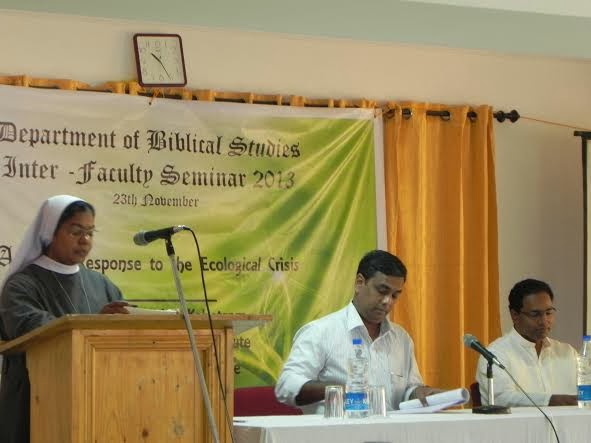
Biblical Studies Inter Faculty Seminar
The annual inter-faculty
seminar of the department of Biblical studies was held at the United Theological
College Bangalore, yesterday. The theme for this year
was “Biblical Response to Ecological Challenges”. The participants were from the St.Peter’s Pontifical Institute, Dharmaram
Vidyakshetram and the United Theological College.
Inaugural Session
The inter faculty seminar was held under the leadership of the Rev. Dr. Dexter Maben, the acting chairperson of the Biblical
Studies Department at the UTC. The postgraduate and doctoral students of UTC
(Biblical Studies) helped in the conduct of the programme. Rev. Rengbi Rangthang (D.Th III, NewTestament) was the coordinator
for this seminar. The seminar began with praise and worship led by Mayang and
team. Rev.Dr. Dexter Maben gave the introduction after which Rev.Dr. C.I.David
Joy welcomed the participants. The
inaugural worship began with the lighting of the lamp by the heads of the institutions and the worship led by the doctoral students under the
coordination of Ms. Sushana Pramanik. Rev.Dr. John Samuel Raj, the principal of
UTC, gave the inaugural address based on Psalm.104:24-31. He challenged the
participants to come out of the narrow anthropocentric approach to a wider
hermeneutics, reading the Bible afresh in the light of the earth crisis. Since
the Bible begins with the creation, it should be given paramount place in our
theological and hermeneutical endeavours, he said.
Papers Presented
Six papers, three from Old
Testament and three from New Testament, were presented in the seminar. Fr.
Jomon Thomas (St. Peter’s) presented the first paper titled “Ecological
Concerns in the Law Codes of Pentateuch”. The presenter pointed out the need to
go back to the scripture to understand how ecological concerns were central to
the Law codes in Pentateuch and to see the progression of thought with regard
to the ecological concerns in these law codes, namely, covenant codes, deuteronomic
codes and holiness code. Three constituent parts of the created world is
emphasised in all these codes, such as land, vegetative world and animal world.
Rev.Dr.John Samuel Raj, the principal of UTC, moderated this session and the
response was given by Sr.Rekha Rose. The participants suggested the need for
taking into consideration the Ancient West Asian context and the practical
applicability of these things in the present scenario. There is a need to
address the issue of power, theology of justice and re-reading of cross-breeding.
The second paper was on “Paul
and Ecology” presented by Sr. Hazel Alexander (DVK). Fr. Dr. Alfred Joseph of
St.Peter’s moderated this session. This was responded by Fr. Suresh Mathew. The
paper anchored on two main passages in the Pauline letters, Rom. 8:19-23; Colo.
1:15-20. This was explained in the light of other passages dealing with
issues like understanding of creation in Pauline writings, the state of
creation, new creation and restoration. The transformation is possible only in
and through Jesus Christ. The paper saw Paul as an ecological prophet. The
paper also gave the implications in the present context and urged the participants to acknowledge the ecological crisis as a spiritual crisis, to develop a new lifestyle with simplicity and coherent with the order of nature and to reconsider the
meaning of well-being in relation to the wider context of society and holistic
harmony with the cosmos. The discussions
from the floor suggested to see Paul and Greco-Roman context on ecology and to
delineate the role of the church, if ecological crisis is a spiritual issue, in
the present scenario. There is a need to bring the implications of new creation
to present ecological crisis, though further clarity is required as to how to
do it.
Ms.Lahtaw Nang Dim Pri (UTC)
presented the paper titled “Wisdom Literature and its Response to Ecological
Crisis”. This session was moderated by Fr.Dr.Joseph Titus (St.Peter’s). The
response was given by Fr. Walter D’Souza. This paper dealt with issues like the
roots of ecological crisis, the major ecological crisis' and the understanding of
creation in wisdom literature. The paper suggested certain theological
implications, especially from a tribal perspective. The questions from the floor
were basically regarding the practical applicability and logical application of this in
the light of the present scenario of development and the need to consider Qoheleth
(for example, in chapter three equality of animal and human is mentioned) in
making a response from the wisdom literature.
The fourth paper titled
“Prophetic concern on Ecology” was presented by Fr.S.Nicholas (DVK). This was
moderated by Rev. Dr. Daniel Jones Muthunayagom (UTC). Mr.Liiduo Lanah B (UTC)
gave the response. The paper considered prophetic concern in general and
Hosea.2:18-23 in particular. The important points of discussion from the floor
were covenant between God and earth, the logic of God punishing nature
whenever humans commit sins, the eschatology and ecological crises, the animal
killing (sacrifice) and ecology.
Fr. Bijeesh Chacko(St.Peter’s)
presented the fifth paper titled “Biblical Response to Ecological Crisis: Synoptic View Point”. Rev. Dr. C.I.David Joy (UTC) moderated this session and
Rev.Saju Mathew(UTC) responded to the paper. The punch line of the paper was
the urge for a change from anthropocentric to life-centred hermeneutics. The
paper has argued that Bible is eco-friendly and the use of the term ‘ochlos’ in
the synoptic gospels can be read as nature from the perspective of marginalisation. The discussion from the floor suggested that it is not only
anthropocentric to bio-centric, but now the shift is to read it from a cosmo centric frame work. Jesus was responding to the Greco-Roman colonisation
on the land of Palestine and its people. Therefore impact of globalisation needs to be addressed. The birth, death and resurrection of Jesus and its connection
with ecology needs further consideration.
The sixth paper titled “In Him
We Live and Move and Have Our Being (Acts.17:28): A Biblical Response to
Ecological Crisis” was presented by Rev.I Limatemsu Ao (UTC). This session was
moderated by Fr.Dr.Sebastian Mullooparambil (DVK). Sr.Hazel Alexander responded
to the paper. The paper was finding out the ecological concerns in the Acts,
especially in the early Christian Kerygma. Discussions regarding the paper were
mainly on the title and its link with ecology.
Concluding session
The concluding session was moderated by
Rev.Dr.Daniel Jones Muthunayagom. The main agenda was regarding the theme for the next meeting at St.Peter’s Pontifical Institute, which will be held on 22nd
November, 2014. Out of the several suggestions, “Economics and Ethics from
Inter-Scriptural Perspective” was proposed as the theme for the next meeting.
This was followed by remarks from representing institutions. Fr. Dr. Joseph
Titus (St.Peter’s) informed the participants regarding the publication of these
paper of the Inter faculty series. Fr. Dr. Sebastian Mullooparambil (DVK) challenged
the participants to become ambassadors of the message (discussions on ecology)
and Rev. Dr. C.I. David Joy (UTC) pointed out the need for more interaction
between seminaries. The commitment song
by Jeviholi Swu and Mayang added colour to the closing ceremony and during this
time representatives from participating institutions poured water on plants as
a symbol of commitment to ecological concerns.
Rev.Dr. Dexter Maben proposed the vote of thanks. There were also
announcements regarding the “BIBLE DARSHAN” the international seminar which is going to be held at the UTC, on January 30-February 1, 2014. The meeting was
concluded with prayer and benediction by Rev. Dr. Daniel Jones Muthunayagom.
Reported by Rev. Biju C.
JK
Friday, 12 July 2013
Bible Darshan 2014
An international conference "Bible Darshan" will be conducted by the department of Biblical Studies of the United Theological College, Bangalore from January 30 to February 1, 2014. Details of the conference are given in the blog http://utcbibledarshan.wordpress.com/
The theme of the conference is "Exploring New Frontiers for Post-Western Biblical Studies." The write up to the theme explains this in detail. The Bible continues to enlighten, renew and challenge individuals and communities, communicating the ‘gospel’ in diverse context (s). Glaring realities of identity, caste, poverty, plurality, and ecological issues continue to challenge, the study of the Bible in India/Asia. Biblical studies as a theological discipline, continues to evolve with positive contributions from the West. However, there is a need to move beyond the enlightenment framework, to rediscover cultural, religious and indigenous resources, which can make the Bible intelligible in our contexts, because they are closer to the Mediterranean world. Further, the need for an inter-disciplinary approach is significant than ever before, which can draw us closer to our cultural and religious heritage. The conference is an attempt to challenge biblical scholars in India and in the West to engage with one another, share insights with each other and evolve new frontiers for further research in India/ Asia, thereby creating a new identity for biblical studies in the country.
While the core areas of biblical studies are still pertinent, the conference aims to draw attention to the significance of the Bible to our own times and context(s). The presentations are intended to cover the Old Testament, New Testament and the Intertestamental literature, with enough space for engagement together and separately. Presentations may focus any one or more of the areas mentioned:
a) Old Testament Hermeneutics
b) Study of Judaism and Religions of the Ancient Near East (ANE)
c) History of Israel
d) God and the Nations
e) Old Testament and the study of other faiths
f) New Testament Hermeneutics
g) Judaism and the religions of the first century CE
h) Construction of the History of the early church
i) Pauline Studies/Gospel Studies
j) New Testament and the study of other faiths
The theme of the conference is "Exploring New Frontiers for Post-Western Biblical Studies." The write up to the theme explains this in detail. The Bible continues to enlighten, renew and challenge individuals and communities, communicating the ‘gospel’ in diverse context (s). Glaring realities of identity, caste, poverty, plurality, and ecological issues continue to challenge, the study of the Bible in India/Asia. Biblical studies as a theological discipline, continues to evolve with positive contributions from the West. However, there is a need to move beyond the enlightenment framework, to rediscover cultural, religious and indigenous resources, which can make the Bible intelligible in our contexts, because they are closer to the Mediterranean world. Further, the need for an inter-disciplinary approach is significant than ever before, which can draw us closer to our cultural and religious heritage. The conference is an attempt to challenge biblical scholars in India and in the West to engage with one another, share insights with each other and evolve new frontiers for further research in India/ Asia, thereby creating a new identity for biblical studies in the country.
While the core areas of biblical studies are still pertinent, the conference aims to draw attention to the significance of the Bible to our own times and context(s). The presentations are intended to cover the Old Testament, New Testament and the Intertestamental literature, with enough space for engagement together and separately. Presentations may focus any one or more of the areas mentioned:
a) Old Testament Hermeneutics
b) Study of Judaism and Religions of the Ancient Near East (ANE)
c) History of Israel
d) God and the Nations
e) Old Testament and the study of other faiths
f) New Testament Hermeneutics
g) Judaism and the religions of the first century CE
h) Construction of the History of the early church
i) Pauline Studies/Gospel Studies
j) New Testament and the study of other faiths
Subscribe to:
Posts (Atom)